Researchers at ISC Konstanz have published new findings on one of the most important reliability challenges facing modern TOPCon solar cells: ultraviolet-induced degradation (UVID).
The paper, authored by David Bäurle together with colleagues from ISC Konstanz, has been published in the renowned journal Solar Energy Materials and Solar Cells.
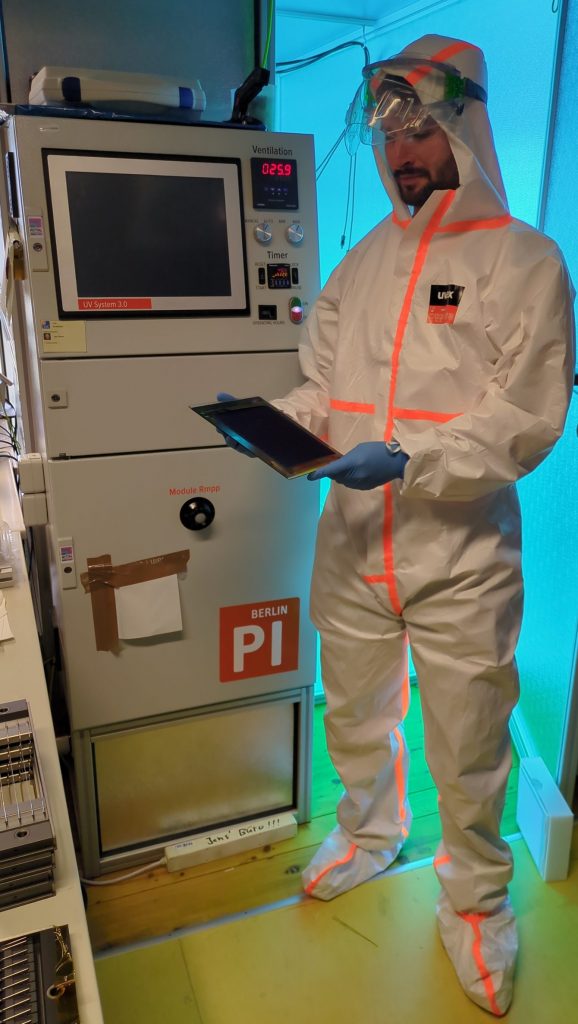
David Bäurle in front of the UV chamber in the ISC Konstanz laboratory
TOPCon has become the dominant crystalline silicon solar cell technology worldwide thanks to its high efficiency and industrial maturity. As the technology continues to evolve, ensuring long-term reliability is becoming increasingly important. One issue attracting growing attention is UV-induced degradation, which can reduce solar cell performance over time.
In the study, the ISC team systematically compared different front-side passivation concepts and investigated how deposition techniques, AlOx layer thickness and interface design influence UV stability.
Among the key findings:
Atomic Layer Deposition (ALD) provides significantly better UV stability than PECVD passivation.
Increasing the AlOx layer thickness further improves resistance against UV-induced degradation.
An additional thermally grown SiOx interfacial layer leads to the highest UV stability among the investigated passivation stacks.
Industrial TOPCon cells from multiple manufacturers showed comparable UV-induced efficiency losses of around 2–3%, while process variations within production can significantly influence degradation behaviour.
The results contribute to a better understanding of degradation mechanisms in TOPCon solar cells and provide practical guidance for further improving long-term module reliability.
Congratulations to David Bäurle and all co-authors on this excellent publication.