ISC Konstanz recently hosted the mid-term General Assembly of the European research project LEEMONS (Low-Energy Electron Multiplication On Nanostructured Solar Cells). Representatives of the project partners met in Konstanz to review the scientific and technical progress achieved during the first 18 months of the project and to plan the activities for the upcoming phase.
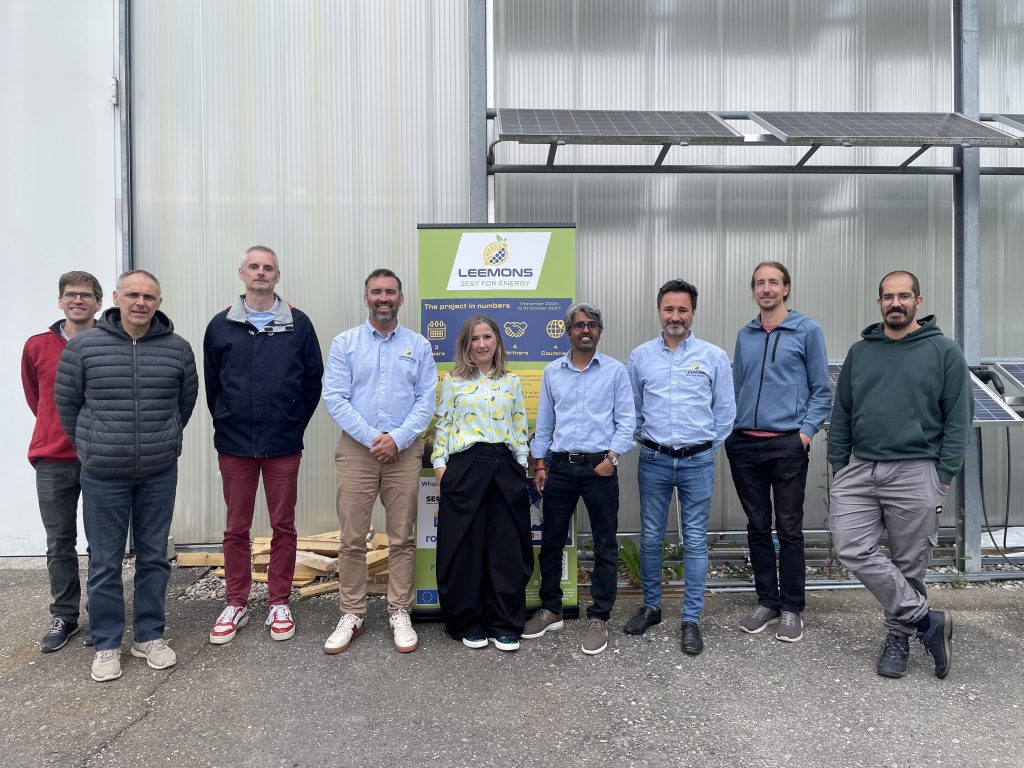
Representatives of the LEEMONS consortium during the mid-term General Assembly hosted by ISC Konstanz. The meeting marked the halfway point of the Horizon Europe project and provided an opportunity to discuss recent progress and define the roadmap towards a proof-of-concept demonstration of carrier multiplication in silicon solar cells.
From Left: Dominik Rudolph (ISCK), Frédéric Milesi (CEA-Leti), Samuel Queste (UMLP), Brice Rouffie (Segton AT), Lacramiora Popescu (ISCK), Lejo Joseph(ISCK), Mikael Hosatte(ISCK), Philippe Wyss (CSEM), Lazhar Rachdi (ISCK). Not in picture: Andrej Miszczuk´,Beata Basta (Roltec-videoconference)
Funded by the European Union’s Horizon Europe programme, LEEMONS investigates a novel approach to increasing the efficiency of silicon solar cells. Unlike tandem technologies, which combine multiple absorber materials, LEEMONS aims to exploit carrier multiplication in nanostructured silicon. In this concept, the excess energy of high-energy photons is used to generate multiple charge carriers instead of being lost through thermalisation.
If successfully demonstrated, this approach could enable higher photovoltaic efficiencies while maintaining a high degree of compatibility with established silicon manufacturing processes.
ISC Konstanz plays a key role in the project by leading the work packages dedicated to n-type solar cell integration and optimisation. The institute is working on integrating the LEEMONS concept into its industrially relevant IBC-ZEBRA solar cell technology. Current research focuses on adapting metallisation and passivation processes while preserving the functionality of the LEEMONS nanolayer.
During the meeting, the consortium reviewed recent achievements and discussed the remaining scientific challenges. The next project phase will focus on validating the most promising technological approaches and generating proof-of-concept electrical results.
“LEEMONS combines ambitious scientific objectives with a strong application perspective,” said Lejo Joseph, Board Member and Head of Solar Cell Development at ISC Konstanz. “Hosting the consortium in Konstanz was an excellent opportunity to strengthen our collaboration and jointly define the next steps towards demonstrating this innovative concept.”
The LEEMONS consortium currently consists of SEGTON Advanced Technology (France), CEA-Leti (France), ISC Konstanz (Germany), ROLTEC (Poland) and (The Marie and Louis Pasteur -University, formerly University of Franche-Comté) (France), CSEM (Switzerland)
The project runs from November 2024 to October 2027.
Views and opinions expressed are however those of the author(s) only and do not necessarily reflect those of the European Union or the European Commission. Neither the European Union nor the granting authority can be held responsible for them.