


Agricultural-Photovoltaics
is the combined use of land by agriculture for food production & photovoltaic for green power generation.
Advantages:
- Increased land use: Combined use leads to a diversification of income & operating cost savings on the same land.
- Environmental impact protection: PV panels protect crop from frost, drought & hails and can be used to harvest rainwater.

Environmental protection – © Ilkay Karakurt
Technical concept:
- PV panels are either ground mounted in vertical rows (Interspace PV) or high mounted (Overhead PV), leaving enough space for agricultural use.
- Both technologies offer unique advantages.

Interspace-PV – ©Next2Sun AG
Interspace PV:
- Bifacial PV panels (e.g. ISC TuKaN technology) are mounted in vertical rows, leaving enough space in between for agricultural use.
- The main advantages are easier management and higher revenues for east-west oriented modules, and lower investment costs compared to overhead PV.
Overhead PV:
-
Overhead-mounted PV modules are used particularly in perennial specialty crops.
-
The main advantages are additional plant protection against environmental influences (e.g., drought or hail) and potential rainwater harvesting.
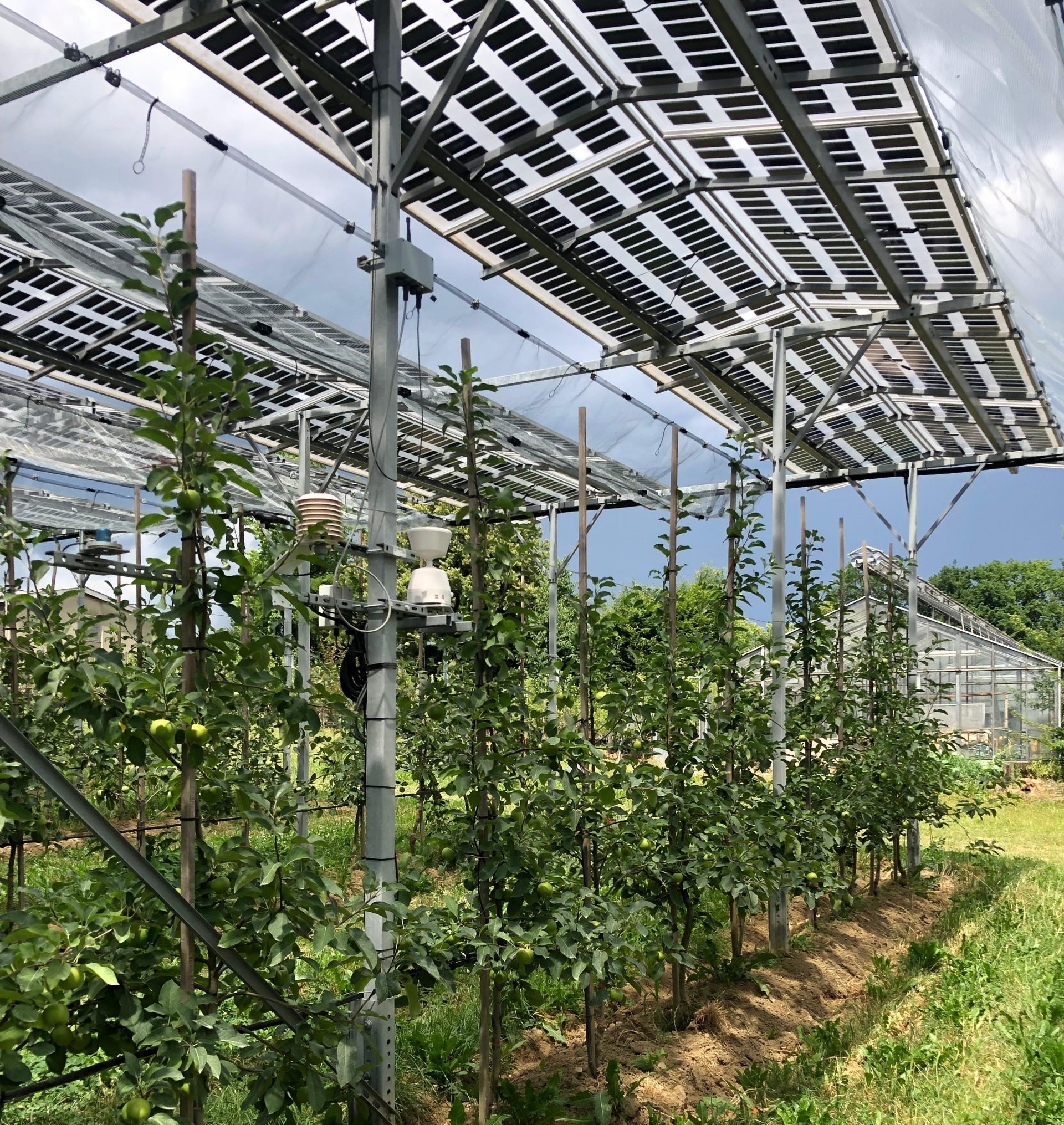
Overhead PV – ©Jens Eickelmann
ISC Konstanz Agri-PV Services:
- Yield prediction for bifacial interspace or overhead PV systems
- Design & economical analysis of Agri-PV systems
- Scientific support of Agri-PV projects
- Collecting and evaluating of measurement data

Part of ISC‘s service for Agri PV projects: measurement and MoBiDiG simulation.
Here: Time-of-day-dependent electrical power of a vertically installed, east-west oriented bifacial PV module.