
In the “Climate & Energy” special edition of the Staatsanzeiger Baden-Württemberg published on 18 September 2026, ISC Konstanz and its partners are promoting a message that is particularly important to us: The energy transition is not only necessary – it is technically feasible, economically attractive and a major opportunity for research, industry and equipment manufacturers in Baden-Württemberg and Europe.
With our advertisement, we want to encourage action and confidence in the transformation ahead. The technologies are available. Solar and wind power are now among the most cost-effective forms of electricity generation, electrification can substantially reduce our overall energy demand, and today’s PV technology already enables the rapid expansion of renewable energy.
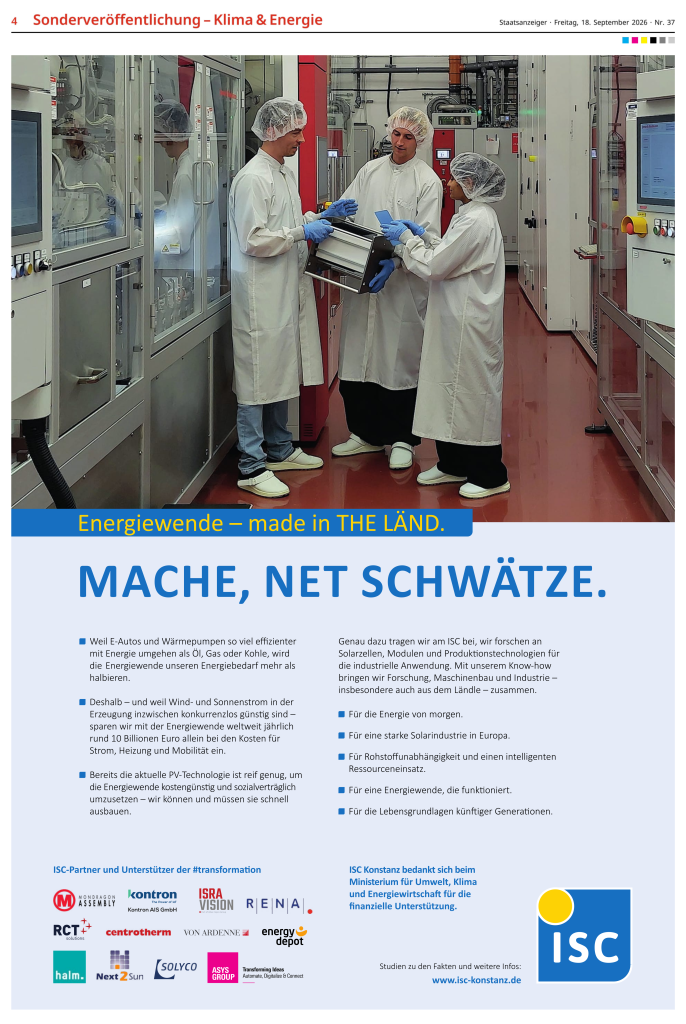
“Energy Transition – made in THE LÄND”: Together with partners from research and industry, the ISC Konstanz is promoting a rapid energy transition and a strong solar industry in Europe.
In our advertisement, we highlight three key points:
- Because electric vehicles and heat pumps use energy much more efficiently than oil, gas or coal, the energy transition can substantially reduce our overall energy demand.
- Wind and solar are now among the most cost-effective forms of electricity generation. A largely electrified, renewable energy system can therefore reduce not only emissions but also global energy costs considerably.
- Today’s PV technology is already powerful and cost-effective enough to make a major contribution to the energy transition. We can expand it rapidly now.
Background information on the statements:
Less energy for the same benefit
One major advantage of electrification is often underestimated: a large proportion of the primary energy used today is lost as heat during combustion and conversion processes. Electric motors and heat pumps can provide the same energy services much more efficiently.
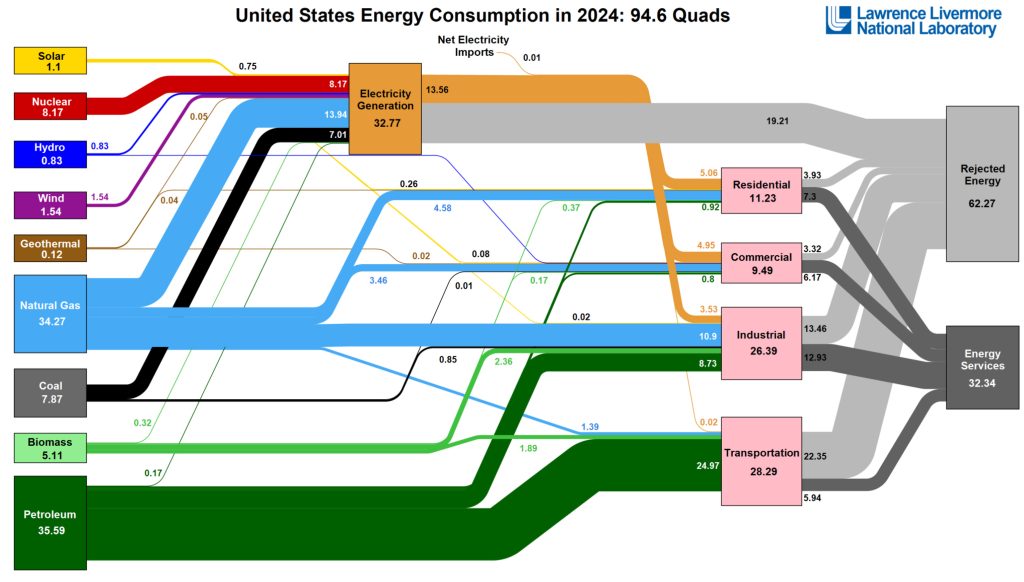
Energy Flows in the U.S. in 2024: The Sankey diagram from the Lawrence Livermore National Laboratory (LLNL) shows where the energy comes from, what it is used for, and what proportion is lost during conversion (“Rejected Energy”).
This is clearly illustrated by the energy flow charts published by the Lawrence Livermore National Laboratory (LLNL). For the United States in 2024, they show energy sources, end uses and the substantial conversion losses in today’s energy system. (Credit: Lawrence Livermore National Laboratory (LLNL), U.S. Energy Flow Chart 2024; Databasis: U.S. Department of Energy / Energy Information Administration.)
Solar energy has long since become an economically competitive technology
A 2023 study published in Nature Communications examines the global development of solar energy. It concludes that the combination of technological progress, learning effects and rapidly declining costs may have pushed the world beyond a tipping point towards solar energy.
The authors model a future in which solar energy can become the dominant technology in global electricity generation under the scenarios investigated. At the same time, they point to challenges that still need to be addressed, including grid integration, financing and supply chains. (Credit: Nijsse, F. J. M. M. et al. (2023): The momentum of the solar energy transition. Nature Communications 14, 6542.)

Solar Energy on Its Way to Becoming the Most Cost-Effective Source of Electricity: The study “The momentum of the solar energy transition” uses 70 regions around the world to show how the most cost-effective electricity generation technology in the model changes between 2020 and 2030. The biggest shift occurs between 2020 and 2027—in favor of photovoltaics. Nature
A renewable energy system can also be economically advantageous
The potential efficiency and cost benefits of a comprehensive energy transition are examined in a study by Mark Z. Jacobson and colleagues covering 145 countries.
In the scenarios modelled in the study – based on wind, water and solar energy, storage and efficiency measures – global end-use energy demand falls by around 56% compared with the reference system. Annual private energy costs decrease from USD 17.8 trillion to USD 6.6 trillion – a reduction of approximately USD 11 trillion per year.
The authors also model substantial additional savings resulting from avoided health and climate-related damage.
The study represents a scenario for a fully transformed energy system, not a forecast. Nevertheless, it illustrates the scale of the economic potential associated with electrification, greater efficiency and renewable energy. (Credit: Jacobson et al.: “Low-cost solutions to global warming, air pollution, and energy insecurity for 145 countries”, Energy & Environmental Science (2022))
Bringing research, equipment manufacturers and industry together
This is precisely where ISC Konstanz comes in. We develop solar cells, modules and production technologies for industrial applications. Together with our partners, we bring research, equipment manufacturers and industry together and work to ensure that innovative PV technologies do not remain in the laboratory but make their way into industrial production.
For us, the energy transition is therefore also an industrial opportunity: an opportunity for innovation, technological expertise and value creation in Baden-Württemberg, Germany and Europe.
MACHE, NET SCHWÄTZE.
Don’t just talk – get things done.
[Download the “Climate & Energy” special edition of the Staatsanzeiger Baden-Württemberg, 18 September 2026 (PDF)]