
A new laminator from the German machinery manufacturer Robert Bürkle GmbH was delivered to ISC Konstanz today. The system was funded as part of an equipment grant awarded by the Umweltministerium Baden-Württemberg in December 2024.
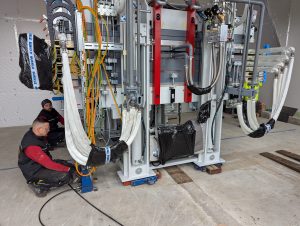
Employees from BÜRKLE carefully position the heart of the laminator in its designated place in the new ISC Konstanz laboratory.
The main unit of the system weighs almost 32 tonnes. With the new laminator, ISC Konstanz can manufacture photovoltaic modules in industrial formats of up to 1.60 m × 2.40 m, matching the dimensions commonly used in modern PV module production.
The system is designed as a special four-level laminator. In industrial production lines, several laminators are typically arranged in sequence, each performing a specific process step. At ISC Konstanz, these process stages are integrated into one machine with four levels, allowing researchers to flexibly study and optimise different lamination processes.
In addition to conventional flat PV modules, the system also enables the production of curved or spherical modules using dedicated negative moulds. Such modules could, for example, be integrated into vehicle roofs or bonnets, allowing electric vehicles to generate solar power while parked, extend driving range, or power cooling systems when exposed to sunlight.
Karl Wienands, project manager at ISC Konstanz, looks forward to the new opportunities the laminator offers: “With the new laminator, we can produce modules in industrial formats while also exploring new concepts such as improved glass-glass modules, faster lamination processes, and curved module designs. This opens exciting possibilities for future research projects and collaborations with industry partners.”
The new system represents another important step in expanding ISC Konstanz’s research infrastructure for the development of next-generation photovoltaic modules.
The expansion of the new ISC laboratories is supported both by public funding – including from the Umweltministerium Baden-Württemberg – and by donations from companies and private supporters. Those interested in supporting the further development of the research infrastructure can find more information here.